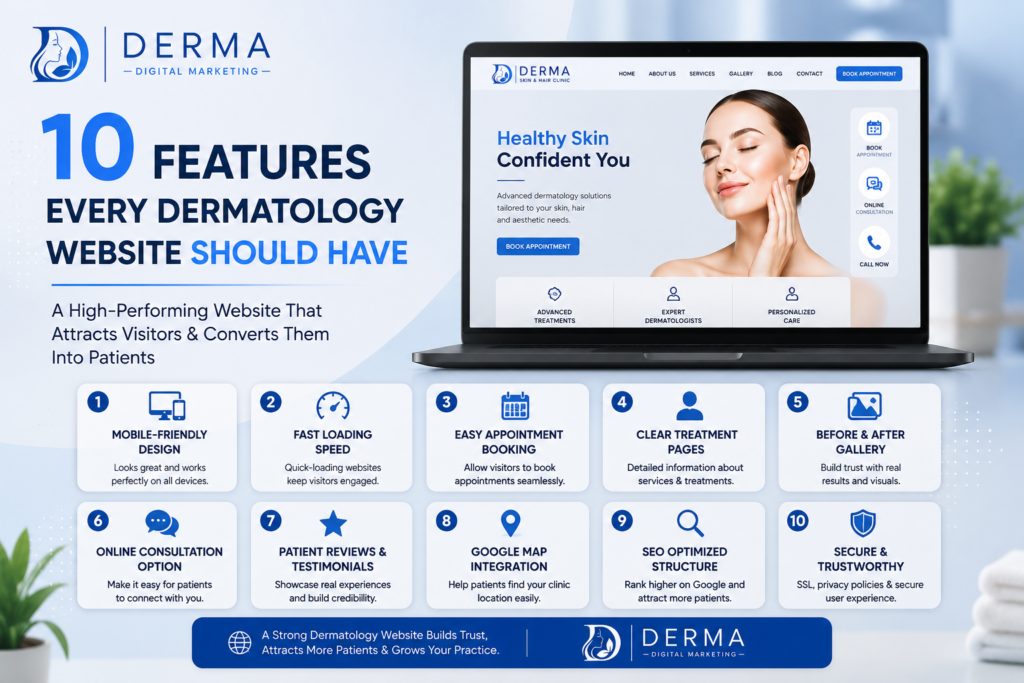
If you run a skin clinic in India, your website is often the first impression a patient gets before they ever sit in your chair. Getting the right Dermatology Website Features in place isn’t just about looking modern, it directly affects whether a worried patient books an appointment or clicks away to a competitor. In a country where patients are increasingly researching skin conditions online before choosing a doctor, a well-built website can be the difference between a full appointment book and an empty one.
In this guide, we’ll walk through the ten features that matter most, why they matter, and how to think about them practically, whether you’re building a new site or improving an existing one.
Think about the last time you searched for a doctor online. Did you judge the clinic by how professional and trustworthy the site felt?
Most patients do the same. Good dermatology website design builds confidence before a single word is exchanged. It signals that a clinic is organized, current, and serious about patient care, qualities patients associate with clinical competence too.
Let’s get into the specific features that make this happen.
A confused visitor rarely becomes a patient. Your menu should answer three questions within seconds: What do you treat? Who treats it? How do I book?
Keep navigation simple:
A cluttered menu is one of the fastest ways to lose a visitor who’s already anxious about a skin concern.
Most patients in India search for a dermatologist website on their phone, often while waiting for a bus or between work breaks. If your site doesn’t adjust cleanly to smaller screens, you lose them instantly.
A responsive site should:
Google also prioritizes mobile-friendly sites in search rankings, so this isn’t just a user experience issue – it’s an SEO one too.
Nobody waits for a slow website, especially when they’re dealing with a skin issue that feels urgent. Every extra second of load time increases the chance a visitor leaves before the page even finishes loading.
Practical ways to improve speed:
A fast site also supports better dermatology website optimization for search engines, since page speed is a known ranking factor.
Generic “Services” pages that just list conditions in one paragraph don’t help patients or search engines. Each treatment, acne, psoriasis, hair loss, laser therapy, skin allergies, deserves its own page.
A strong service page should include:
This approach is central to good dermatology website development, as it helps patients self-identify their concern and gives Google clear, indexable content to rank.
Patients want to know who they’re trusting with their skin. A dedicated doctor profile page should include qualifications, years of experience, areas of specialization, and professional affiliations.
This isn’t just good practice, it directly supports EEAT (Experience, Expertise, Authoritativeness, Trustworthiness), which search engines increasingly consider for medical content. A vague “Dr. Sharma is our expert dermatologist” line doesn’t cut it anymore.
An easy booking system removes friction at the exact moment a patient has decided to act. If they have to call during clinic hours or fill out a clunky form, some will simply give up.
Look for a booking feature that:
This single feature can noticeably increase conversions on any skin clinic website design.
Visual proof matters in dermatology more than most specialties. A well-organized gallery of treatment results, with patient consent and no misleading edits – helps set realistic expectations.
Keep this section honest:
Overpromising here can backfire, both ethically and in terms of patient trust.
Visual proof matters in dermatology more than most specialties. A well-organized gallery of treatment results, with patient consent and no misleading edits – helps set realistic expectations.
Keep this section honest:
Overpromising here can backfire, both ethically and in terms of patient trust.
A regularly updated blog is one of the most underused features in website for dermatologists projects. Articles on common skin concerns, seasonal skincare tips, or myths versus facts do two things at once – they help patients and they improve organic search visibility.
Content ideas that consistently perform well:
This is also where secondary keywords around dermatology website best practices naturally fit, without forcing them into unrelated pages.
This sounds basic, but many clinic websites bury their address, phone number, or clinic hours. Every location page should clearly show the clinic’s address, a map, phone number, and hours, ideally repeated in the footer.
If you have multiple branches across cities in India, a location-specific page for each helps both patients and local search rankings.
Health information is sensitive, and patients notice when a site feels secure – or doesn’t. Basic requirements include an SSL certificate (the padlock icon in the browser), a clear privacy policy, and secure handling of any forms collecting personal or medical details.
This isn’t optional. Beyond patient trust, Google actively favors secure (HTTPS) websites in search results.
Building a dermatology website isn’t about adding every trendy feature available – it’s about removing friction between a patient’s concern and your clinic’s care. Whether you’re focused on dermatology web design for a single clinic or a multi-branch practice across India, these ten features cover the fundamentals that matter most for both patients and search visibility.
If you’re currently reviewing your own site, it’s worth asking: does it make a nervous, first-time visitor feel confident enough to book an appointment? If the honest answer is no, that’s usually a good starting point for improvement.
A clinic in India looking to strengthen its online presence doesn’t need to overhaul everything overnight – even addressing two or three of these areas can noticeably improve patient inquiries over time.
The most important Dermatology Website Features include mobile-responsive design, fast loading speed, detailed service pages, doctor profiles, and easy online appointment booking. Together, these help patients find information quickly and build trust before their first visit.
Good dermatology website design reduces friction at every step, from finding a treatment page to booking an appointment. A clear, professional layout reassures patients and encourages them to take action instead of leaving for another clinic’s site.
Most patients search for a dermatologist website using their phones, often while multitasking. If the site doesn’t display properly on mobile, visitors are likely to leave, which also hurts search rankings since Google prioritizes mobile-friendly sites.
A dermatology clinic website targeting Indian patients should include clear clinic addresses, local contact numbers, location-specific pages for multiple branches, and content relevant to common skin concerns in Indian climates.
Regularly publishing educational articles supports dermatology website optimization by answering common patient questions, building topical authority, and giving search engines fresh, relevant content to index and rank.
We are a niche digital marketing agency helping dermatologists and skin clinics across Mumbai and Thane.